The one-sentence answer
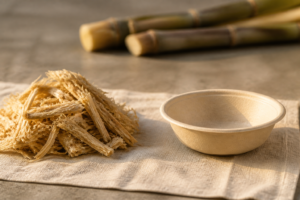
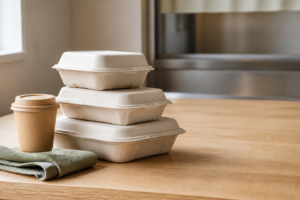
Bagasse is the dry, fibrous residue left after sugarcane stalks are crushed to extract their juice. For most of industrial history it was a waste stream — burned for boiler fuel or stockpiled at the mill. Today it is pressed into plates, bowls, clamshells and trays that look and behave much like the disposable tableware they replace.
That is the short version. The details are what determine whether a bagasse product performs for your menu or falls apart under it.
Where bagasse comes from
Sugar production is a two-output process. The stalk is crushed, the sugary juice is drawn off for refining, and what remains is a mass of fibrous plant material. That residue is bagasse.
Two consequences follow from this origin, and both matter commercially:
Bagasse is a by-product, not a purpose-grown crop. No additional land, water or growing cycle is required to produce it — the sugarcane was already being cultivated for sugar. That is the core of its environmental argument, and it is a genuinely strong one.
Its quality varies with its source. Fiber length, moisture content and residual sugar content differ between mills, sugarcane varieties and harvest seasons. This is why two “bagasse” plates from two suppliers can behave quite differently. The material name is not a quality guarantee.
How bagasse becomes packaging
The manufacturing route is molded fiber production, and it happens in five stages.
1. Collection and cleaning. Bagasse leaves the mill and is screened to remove grit and stray material.
2. Pulping. The fiber is mixed with water and broken down into a uniform pulp. Some producers add a small proportion of other fiber or a food-safe additive to tune strength and water resistance.
3. Forming. The pulp is drawn onto a shaped mesh tool under vacuum, building up a layer of fiber in the approximate shape of the finished item.
4. Drying. The formed part is dried to drive off moisture.
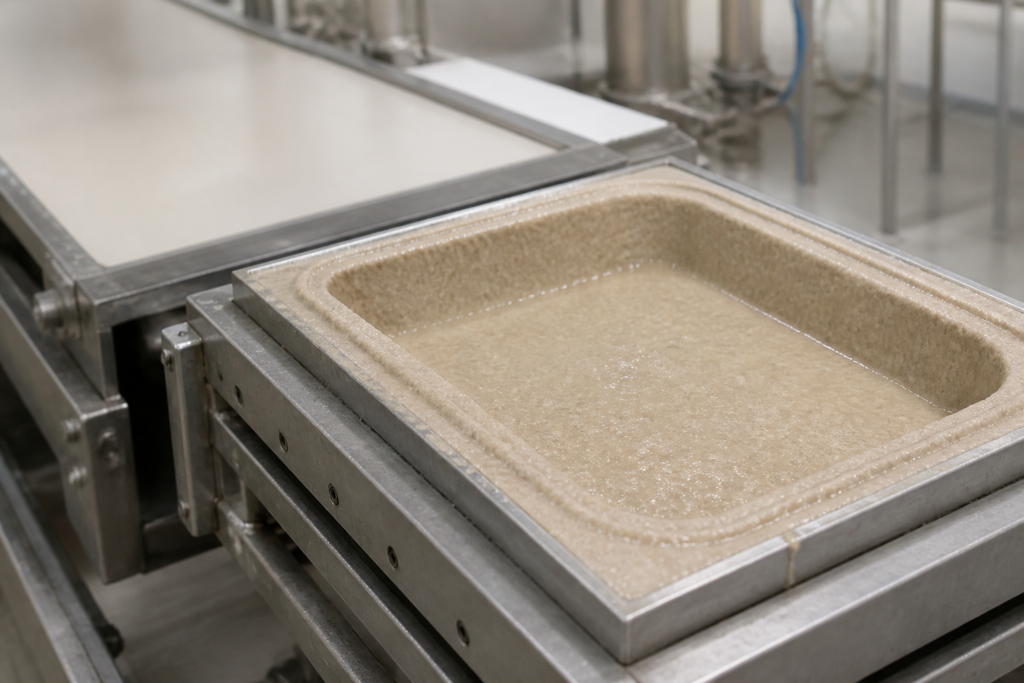
5. Hot pressing. The dried part is pressed between heated matched molds. This step is what gives bagasse tableware its characteristic smooth surface and its rigidity, and it is where most of the performance differences between suppliers are created.
The pressure and temperature used in that final press — along with the fiber blend — determine how dense the finished product is, and density drives heat resistance, rigidity and moisture performance.
Why bagasse performs the way it does
Molded bagasse handles hot, wet and oily food unusually well for a fiber material, and the reason is structural rather than chemical.
The hot-press step produces a dense, low-moisture, lignin-reinforced fiber matrix. There is no plastic coating doing the work. Grease and water resistance come from the fiber structure itself, which means there is no applied layer to delaminate, scratch through, or complicate the end-of-life story.
That has three practical consequences for operators:
- Heat. Quality bagasse grades handle hot food and reheating without deforming — a meaningful advantage over standard PLA, which softens at far lower temperatures.
- Grease. Oily foods that would bleed straight through uncoated paperboard are held by the fiber matrix.
- Rigidity. The pressed structure supports a loaded clamshell in a delivery bag better than most paper formats of equivalent thickness.
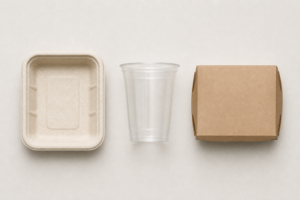
The trade-off is surface finish. Bagasse has a subtly textured, matte appearance — attractive in a natural-fiber way, but not a blank canvas. Where you need full-surface print, paperboard still wins.
What bagasse is not
Three misconceptions cause most of the bad purchasing decisions.
It is not “made from food.” Bagasse is the leftover after the food value has already been extracted. Using it does not divert edible material from the food supply.
It is not automatically compostable in your customer’s backyard. Most bagasse tableware is certified for industrial composting, where sustained high temperatures do the work. In a home compost heap or in landfill, it breaks down far more slowly than the marketing language implies. If a home-compostable claim matters to you, that is a specific certified product — not a property of the material.
It is not automatically more expensive. Bagasse sits above uncoated kraft paper on unit price, but below it once you count grease failures, leakage and replacements.
The forms you will actually buy
Molded fiber production scales across a wide format range, and the standard foodservice line-up is well established. Our bagasse tableware range covers the formats most operators standardise on:
- Plates and platters — from small side plates to compartmented trays
- Bowls — round and square, for hot and cold service
- Clamshells — hinged and lidded, for takeaway and delivery
- Trays and containers — for high-volume back-of-house and catering
Most of these exist in more than one size and wall thickness, and the difference between them is not cosmetic.
Where bagasse fits — and where it does not
| Application | Fit | Why |
|---|---|---|
| Hot takeaway mains | Excellent | Heat and grease resistance without a coating |
| Delivery and ghost kitchens | Excellent | Rigidity survives the delivery window |
| Catering and events | Excellent | Matched sets across plates, bowls and trays |
| Cold salads and desserts | Good | Performs well, though PLA is often cheaper |
| Hot beverages | Not ideal | Paper cup formats generally serve this better |
| Dry baked goods | Workable | Kraft paper is cheaper and prints better |
For operators running a mixed menu, the usual pattern is bagasse for the hot and oily side, paper for the dry and branded side. Our restaurant packaging section walks through how that split works in practice.
How to specify it properly
Once you have decided bagasse is the right material, the specification conversation determines whether you get a product that works.
- Ask for the fiber source and the press spec — not just the material name.
- Ask for the temperature rating of the specific SKU.
- Ask which composting standard the finished product is certified to, and request the certificate.
- Test with your worst dish, over your longest delivery window.
- Confirm the format will still be in production next season.
For a broader comparison of how bagasse stacks up against the other compostable options, see the packaging materials guide.
Frequently asked questions
Is bagasse microwave safe?
Quality molded grades are generally used for reheating. They are not designed for extended cooking, and they should never go near an open flame. Always confirm against the specific product’s rating.
Is bagasse freezer safe?
Yes. Molded fiber holds up well at freezer temperatures, which makes it practical for prepared meals.
Is bagasse plastic-free?
The fiber itself is plant material. Some products include a small proportion of additives or a lining to tune performance, so if a plastic-free claim matters to you, ask for the full material declaration rather than assuming.
Is bagasse the same as molded fiber?
No. Molded fiber is the manufacturing process. Bagasse is one of several fibers that can be used in it, alongside bamboo, wheat straw and recycled paper.
Next step
If you are evaluating bagasse for a specific menu, tell us what you serve and how it travels. We will map it to the right format and send samples so you can test with your own food.