Three materials, three different jobs
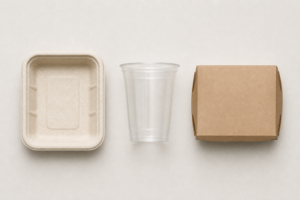
Operators switching away from foam and rigid plastic usually arrive at the same shortlist: molded bagasse, PLA, and kraft paper. All three carry some version of a “green” claim. Almost none of them behave the same way in service.
The mistake is treating them as interchangeable substitutes for a single material. They are not. Each one wins in a different part of the menu, and the right choice is decided by three questions about your food, not by which material sounds most sustainable.
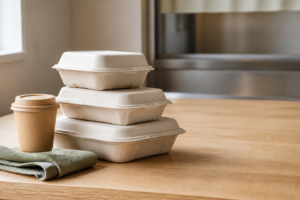
If you serve hot, wet or greasy food — soups, curries, fried chicken, anything with sauce — molded sugarcane bagasse is normally the safest all-round choice.
If you serve cold food and drinks — iced coffee, chilled desserts, salads served cold — PLA is lighter, clearer and frequently cheaper.
If you serve dry or low-moisture goods — pastries, cookies, sandwiches, dry snacks — kraft paper gives you the best print surface at the lowest unit cost.
Everything below explains why those three lines hold, and where they break down.
Side-by-side comparison
| Bagasse (molded sugarcane fiber) | PLA (polylactic acid) | Kraft paper | |
|---|---|---|---|
| What it is | Fibrous residue left after sugarcane juice extraction, pressed into shape | Bioplastic derived from plant starch or sugar | Unbleached wood-pulp paper |
| Best suited to | Hot, wet, oily food | Cold and chilled food, cold drinks | Dry, low-grease food |
| Heat performance | Strong — thermoformed grades routinely handle hot food and reheating | Limited — standard PLA softens in the roughly 50–60 °C (120–140 °F) range; heat-stabilised CPLA grades are far more tolerant | Moderate — depends almost entirely on the coating |
| Grease resistance | Good, without a coating | Good, but heat-sensitive | Poor unless coated or lined |
| Microwave | Yes, for reheating | Not for standard PLA | Only for specific ovenable grades |
| Freezer | Yes | Yes | Yes, but moisture softens the board |
| Compostability | Industrial composting; a growing number of home-compostable grades | Industrial composting | Uncoated yes; coated grades depend on the coating |
| Print / branding | Limited — the molded surface is textured | Limited — generally pad-printed | Excellent — full-surface print |
| Relative unit cost | Mid | Low to mid | Low |
Treat every figure in that table as an industry-typical range, not a specification. Real ratings vary by SKU, wall thickness and grade. The only number that matters is the one on the spec sheet of the product you are actually buying.
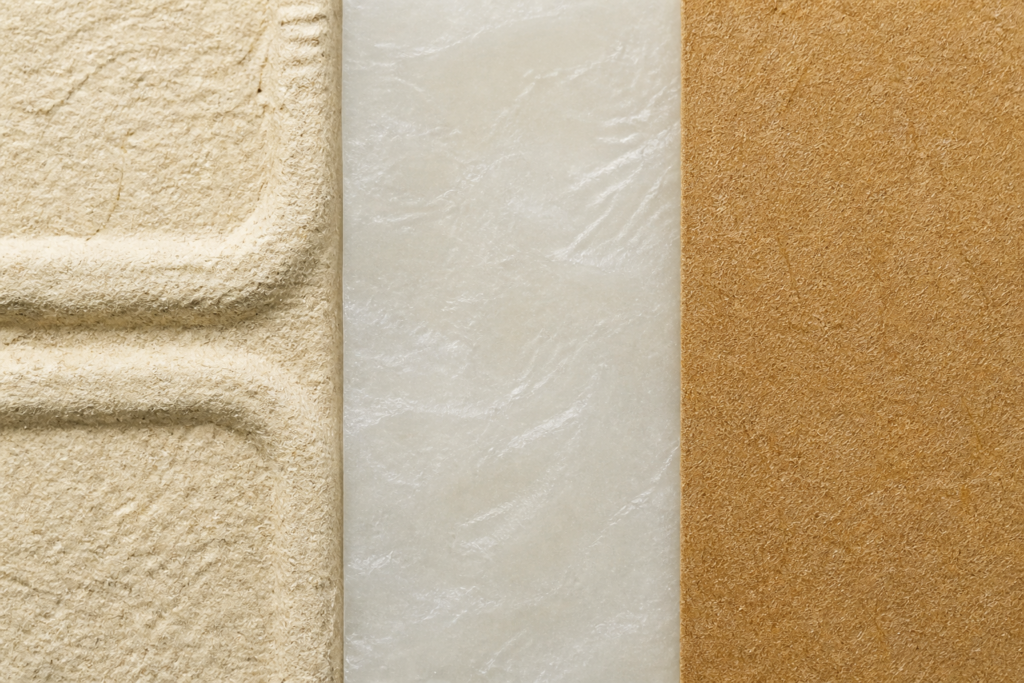
Why heat decides most menus
Heat is where the three materials separate fastest, and where optimistic assumptions cause the most operational damage.
Standard PLA has a low softening point. That makes it excellent for a cold cup or a dessert container, and a poor choice for a hot soup, a steam-heavy takeaway box, or a delivery bag where food sits at temperature for twenty minutes. Heat-stabilised CPLA grades raise that ceiling substantially, but they are a different product at a different price — and they should be specified as such, not assumed.
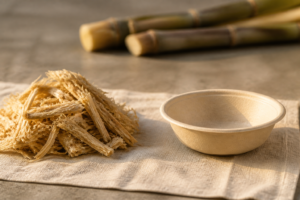
Molded bagasse handles heat well because of how it is made. The fiber is pulped and pressed under high pressure and temperature, which produces a dense, low-moisture structure that resists deformation. That is also why bagasse is the usual answer for clamshells, bowls and plates carrying hot, heavy food.
Kraft paper sits in between and is the most dependent on its coating. Uncoated board is fine for dry food and will fail quickly under a wet, hot load.
The practical test: don’t trust a rating. Fill a sample with your single worst dish — the greasiest, wettest, hottest thing on your menu — and leave it for the length of your longest delivery window. If it holds, it holds.
Grease and moisture: where kraft paper usually loses
Grease is the second filter, and it eliminates kraft paper from more menus than any other factor.
Uncoated kraft has minimal grease resistance. Oil migrates into the board, and the container starts to look — and feel — compromised before the customer is halfway through the meal. Coatings fix this, but the coating becomes part of the specification: PE-coated board performs well and is not compostable, while water-based and PLA-coated grades offer a compostable path at a higher price and a narrower performance window.
Bagasse’s advantage is that it resists grease as a property of the fiber structure rather than as an applied layer. There is no coating to fail, delaminate or complicate the compostability claim.
“Compostable” is a claim, not a material property
This is the single most common sourcing error. Bagasse, PLA and kraft paper are all capable of being compostable. Whether the container in your hand actually is depends on the finished product and the standard it was tested against.
Two distinctions matter commercially:
Industrial vs. home composting. Most PLA and coated fiber products are certified for industrial composting only — they need the sustained high temperatures of a commercial facility. Placing them in a home compost heap produces the same result as placing them in landfill. If your customer-facing claim implies backyard composting, you need a product certified for that specific environment.
Certification, not material name. Compostability is verified by a certification body against a published standard, and the logo on the packaging is the evidence. A supplier describing a product as “compostable bagasse” without a certificate number is making a marketing statement, not a technical one.
This is also why the specification conversation should always move from material to certificate. If you want to know what documentation a supplier should be able to produce, see our certifications reference.
What it actually costs
Unit price is the number buyers compare and the worst number to decide on.
The real comparison is total cost per served item: unit price, plus breakage and leakage, plus the cost of a compliance claim you cannot document, plus the cost of a customer complaint you have to absorb. A marginally cheaper container that leaks grease fails that calculation immediately.
Bagasse generally sits above kraft paper and above standard PLA on unit price, and below both once failure rates and documentation are counted. For a full breakdown of how the materials differ at the fiber level, see the packaging materials guide.
A menu-by-menu shortlist
| Your operation | Start with |
|---|---|
| Coffee shop / café | Double-wall paper cups; bagasse for hot food items |
| Quick-service restaurant | Bagasse clamshells and bowls; kraft for dry wraps |
| Catering and events | Bagasse plates, bowls and trays as a matched set |
| Bakery / deli | Kraft paper bags and boxes; coated board where grease is present |
| Ghost kitchen / delivery-only | Bagasse — it survives the delivery window |
Our bagasse tableware range covers plates, bowls and clamshells in the formats most operators standardise on.
The five-point sourcing checklist
- Ask for the temperature rating of the specific SKU — not the material category.
- Ask which composting standard it is certified to, and by whom — then ask for the certificate.
- Test with your worst dish, not your average one.
- Confirm the coating chemistry if the product is paper-based, and whether that coating is compatible with your sustainability claim.
- Check supply continuity — the best material is useless if the format is discontinued mid-season.
Next step
Tell us what you serve and how it travels, and we will recommend the material and format that fits — including samples for a real-world test with your own menu.