The rules are no longer a coastal-city story.
If you operate a restaurant, coffee shop, ghost kitchen or catering business in the United States, the question is no longer whether single-use plastic restrictions will reach you. It is which of your items — and which of your delivery markets — are already covered.
Two 2026 dates make the point. New York extended its foam ban to cold-storage containers on January 1, 2026. Virginia’s ban on expanded polystyrene food service containers reached every food vendor in the state on July 1, 2026. Both apply to operators across the whole state, not just major cities — see our packaging for restaurants guide for what that means at the counter.
This article covers what operators actually have to do, who is legally on the hook, and how to tell a compliant alternative from a marketing claim.
The four layers of regulation you will run into
1. Carryout bag bans. Statewide, and in many municipalities, plastic carryout bags are prohibited at checkout, sometimes with a minimum charge on paper or reusable replacements. Restaurant takeout bags are treated differently from retail bags in several states, so read the definitions rather than assuming.
2. Expanded polystyrene (EPS) foam bans. This is the layer most likely to affect your packaging directly. Prohibitions typically cover plates, cups, bowls, trays, lids and hinged clamshell containers used for prepared food.
3. Accessory-on-request rules. Straws, cutlery, condiment packets and lids supplied only when a customer asks. These are usually local ordinances, and they change your service workflow, not just your purchasing list.
4. PFAS-in-packaging restrictions. Separate from plastic bans but aimed at the same shelf. New York, for example, has prohibited the distribution and sale of food packaging containing intentionally added PFAS since December 31, 2022. The rule covers packaging intended for direct food contact that is made mainly of paper, paperboard or other plant-fiber material — which includes most fiber tableware.
That fourth layer catches operators off guard. Switching from foam to fiber solves the foam problem. It does not, by itself, solve PFAS.
New York: the food service ban, and what came next
New York’s Expanded Polystyrene Foam Containers and Polystyrene Loose Fill Packaging Ban took effect January 1, 2022, under Environmental Conservation Law Article 27, Title 30. Covered food service providers and stores may not sell, offer for sale or distribute disposable food service containers containing EPS.
The banned container list is broad: bowls, cartons, hinged “clamshell” containers, cups, lids, plates, trays, and any other product designed or used to temporarily store or transport prepared food or beverages.
Effective January 1, 2026, the state added EPS containers designed or intended for cold storage — including coolers and ice chests — unless they are wholly encapsulated or encased within a more durable container.
Exemptions are narrow. The law does not apply to raw meat, pork, seafood, poultry or fish sold for off-premises cooking; prepackaged food filled or sealed before it reaches the provider; or food service containers made from rigid polystyrene resin that has not been expanded, extruded or foamed (for example, clear #6 containers).
There is a financial hardship waiver, renewable for twelve months, and eligibility is restrictive. Covered food service providers must have annual gross income under $500,000 per location, operate fewer than ten locations in the state, and not operate under a franchise agreement. Nonprofit facilities such as community meal programs, food pantries and places of worship may also apply.
Virginia: July 1, 2026
Virginia reached full effect on July 1, 2026. Under the state rule, no food vendor of any type may dispense prepared food to a customer in an EPS food service container.
“Food vendor” is deliberately wide. It covers restaurants, delis, grocery stores, supermarkets, cafeterias and catering vehicles — and also hospitals, nursing homes, assisted living facilities, childcare facilities, schools, correctional facilities and nonprofit organizations that regularly provide food as part of their services.
Two details from the Virginia Department of Environmental Quality are worth remembering:
The ban covers plates, cups, bowls, trays and hinged containers used for prepared, ready-to-consume food. It does not cover packaging for unprepared food such as raw or uncooked meat, fish or eggs, or packaging used to ship food, such as a cooler.
A locality may grant a one-year exemption where compliance would impose an undue economic hardship.
Who is liable: usually you, not your distributor
This is the most common misunderstanding. Virginia DEQ states plainly that the food vendor is the responsible party, and that buying containers through a distributor does not move the obligation. If the ban imposes an undue economic hardship, the vendor must request an exemption from its locality.
New York adds a wrinkle that surprises multi-unit operators: a financial hardship waiver covers only the facility or provider that received it. It does not extend to other entities in the same distribution chain — including distributors supplying a waived facility.
The trap: your city may be stricter than your state
Several states preempt local plastic regulation, meaning only the state legislature can regulate these items. Others do the opposite. New York exempts New York City and any county that enacts a ban at least as protective as state law and files a written declaration with DEC, while preempting weaker local laws.
Many restrictions in the United States exist only at municipal level. The practical consequence: your compliance scope is the union of state, county and city rules across every market you deliver into — not the state where you are headquartered.
What actually counts as a compliant alternative
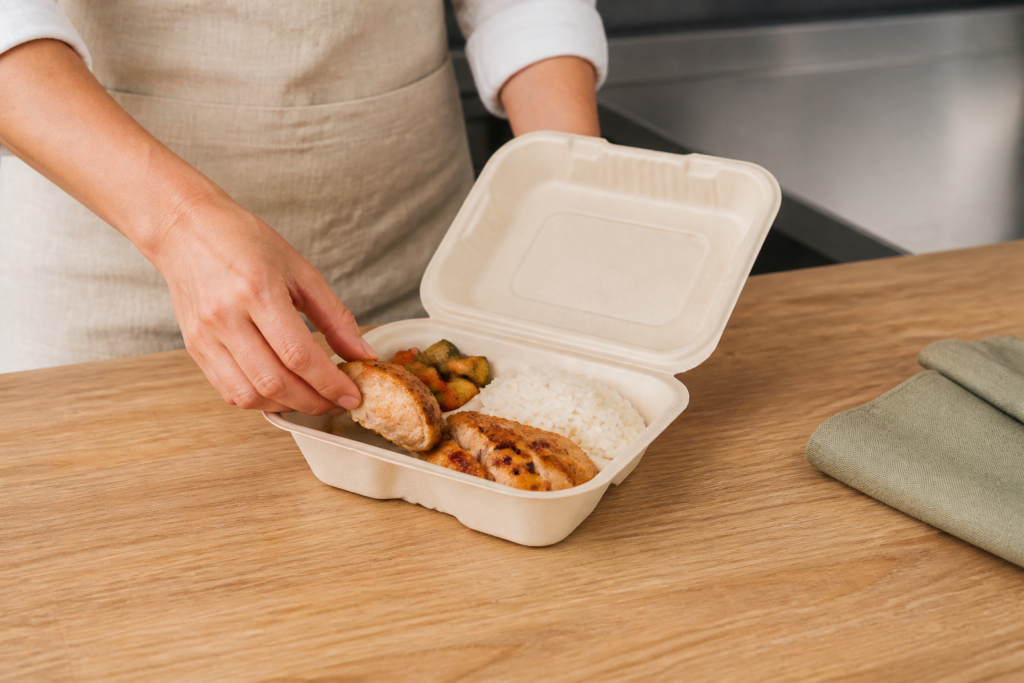
Virginia DEQ lists the alternatives it recognizes: reusable containers; paper products including virgin or recycled paper and plant fibers such as bagasse, bamboo or wheat straw; recyclable plastic such as PET; and foil or metal.
Two cautions before you standardize on one material.
“Compostable” is not a universal pass. Compostable serviceware needs appropriate end-of-life handling. Where industrial composting is unavailable, a compostable item may still be landfilled, and some ordinances specify recyclable or reusable items instead.
Fiber is not automatically PFAS-free. Grease and water resistance in fiber packaging has historically come from PFAS chemistry. If you are replacing foam with fiber in a state that also restricts PFAS in food packaging, confirm the status of the specific item, not the category. Our PFAS-free bagasse clamshells exist for exactly this reason.
A practical compliance checklist
- Inventory every disposable item that contacts prepared food or beverages.
- List every jurisdiction you operate in and deliver into — state, county and city.
- Read the definitions of “prepared food” and “food service container.” They decide your scope.
- Check exemption and waiver windows before relying on them; they are time-limited and narrow.
- Get documentation from suppliers: material composition, PFAS status, and the applicable standard.
- Phase the changeover ahead of the deadline. Sudden switches create stockouts and menu gaps.
What to ask your packaging supplier
- What is this item made from, specifically?
- Is it intentionally PFAS-free, and can you document it?
- Which of my delivery markets accept this material as compliant?
- What certifications apply to this specific SKU?
- Can you hold a specification and supply it as a repeat program?
Good answers come with documents. If a supplier answers “it’s eco-friendly,” you do not yet have an answer.
Where Max Green Pack fits
We manufacture PFAS-free paper and bagasse foodservice packaging in Thailand and ship to North America. Our range covers the formats most affected by these rules — hinged clamshells, paper cups, bowls, trays and takeout boxes — and we supply composition documentation with quotations so your compliance team can verify before you commit.
Tell us your market and your menu, and we will map the items that need changing.
Request a compliance-ready quotation →
Compliance note. This article summarizes state-level rules for general guidance and is not legal advice. Regulations change, and local rules can be stricter than state law. Verify against the current statute and your own jurisdictions before making purchasing decisions.
Sources
- New York State Department of Environmental Conservation — Expanded Polystyrene Foam Containers and Polystyrene Loose Fill Packaging Ban: https://dec.ny.gov/environmental-protection/recycling-composting/nys-plastics-reduction-laws/go-foam-free
- Virginia Department of Environmental Quality — Foam-Free Resources: https://www.deq.virginia.gov/land-waste/waste-management/litter-prevention/foam-free-resources
- National Conference of State Legislatures — State Plastic Bag Legislation: https://www.ncsl.org/environment-and-natural-resources/state-plastic-bag-legislation