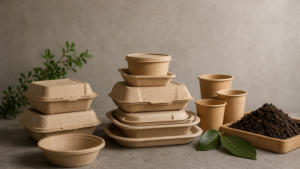
Most coffee shops switch to compostable packaging one item at a time — a cup here, a lid there — and end up with a mismatched set that costs more than it should and still draws complaints about lids that weep. This guide covers the whole picture: what a coffee shop actually stocks, how to get heat retention and lid fit right, and how to order without overcommitting on your first run.
Sourcing packaging for coffee shops is now a mature exercise. The materials exist, they are stocked in standard sizes, and the real risk is not availability — it is specifying the wrong item for your menu.
Why the pressure to switch keeps building
Three forces push coffee shops away from foam and toward fiber and paper.
Regulation. A growing number of jurisdictions restrict expanded polystyrene foodservice items, and paper or fiber alternatives are usually the simplest compliant swap. If you operate in more than one city, assume the rules keep tightening.
Customer expectation. A cup leaves your counter and walks down the street. When it carries your logo it is a moving advertisement — and a foam box undermines the specialty positioning you paid for.
Operational reality. The old objection to compostable packaging was that it went soft, leaked, or collapsed under a hot lid. That objection has largely expired. Modern molded fiber and coated paper hold up to the same service conditions as their plastic predecessors, provided you match the specification to the job.
The full setup: what to stock behind the counter
A coffee shop’s packaging list is longer than most owners expect on day one. Grouped by function, a complete setup looks like this:
- Hot beverage cups — single wall, double wall, or ripple wall, in your core drink sizes
- Hot cup lids — sip lids for coffee, dome lids for foam and whipped drinks
- Sleeves — only if you are running single wall cups
- Cold cups and lids — for iced drinks and cold brew
- Soup and salad bowls with lids — for soup, grain bowls, and grab-and-go salads
- Clamshells and takeout boxes — for sandwiches, pastries, and hot food
- Paper bags and carriers — for multi-item and delivery orders
- Napkins, stirrers, and cutlery — the items that quietly break a compostable claim if you leave them plastic
The last point matters most. A compostable bowl in a plastic-lined bag, with a plastic fork, is not a compostable order — it is a mixed-waste one.
Hot cups: heat retention and lid fit
Hot cups are where most first-time buyers overspend or under-specify, and the fix is understanding the three wall constructions.
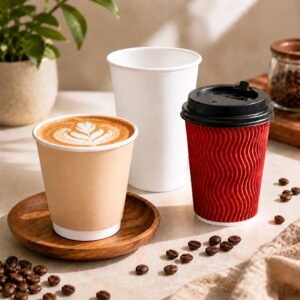
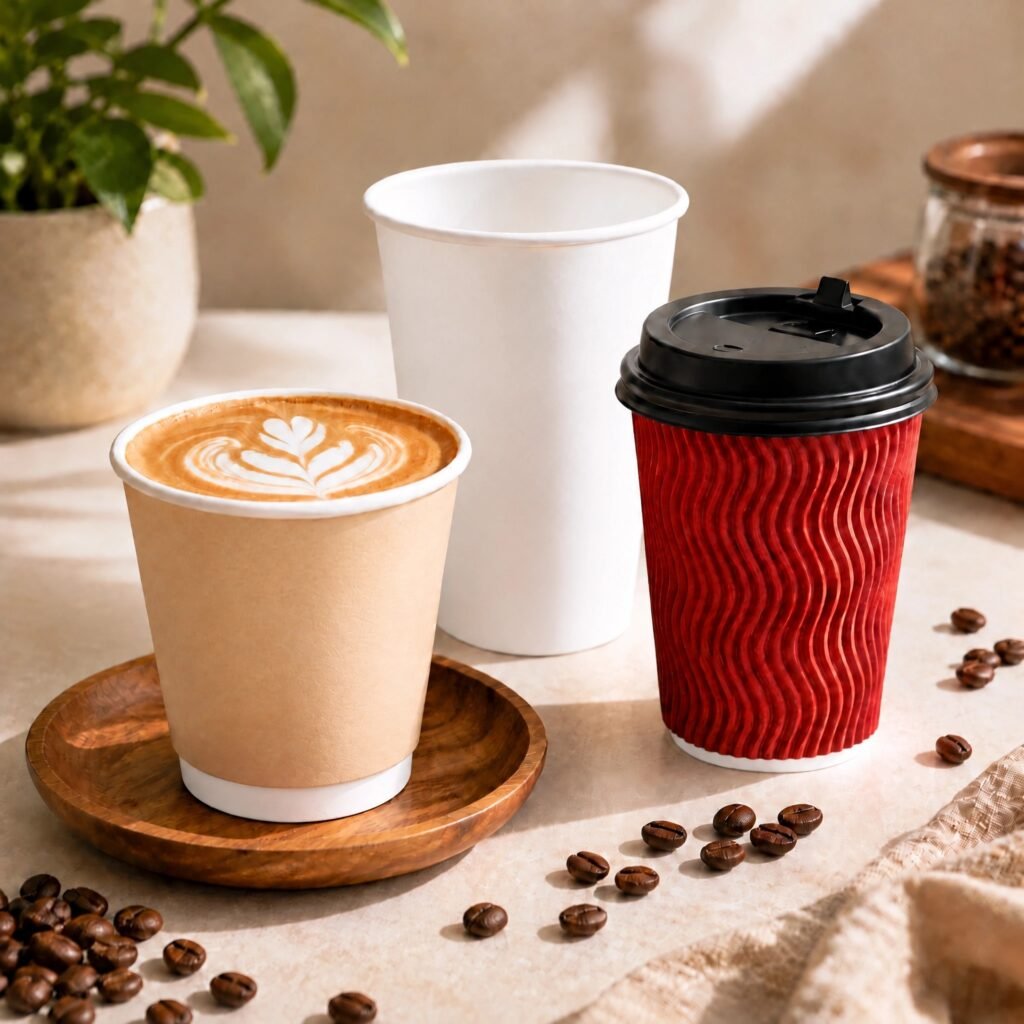
Single wall cups are one layer of paper. They are the cheapest option and perfectly serviceable if you hand out a sleeve with every drink — skip the sleeve and you get complaints about hot fingers.
Double wall cups bond a second layer of paper around the outside, creating an insulating air gap. They hold heat noticeably better and let you drop the sleeve entirely, which usually offsets the higher unit price once you account for the sleeve you no longer buy.
Ripple wall cups use a corrugated outer layer, so they insulate well and add a tactile, premium feel in the hand — a good fit for premium price points.
Two specification details decide whether a cup actually works in service. First, lid fit — order cups and lids as a matched pair from the same supplier, because a millimetre of rim variance is the difference between a sealed lid and a leaking one. Second, coating — hot cups need a water barrier, and the coating type determines whether the cup is accepted in your local compost stream. Our double wall paper cups range lists the available sizes and lid pairings.
Beyond drinks: soup, salad and grab-and-go
Food packaging is where a coffee shop’s setup usually falls out of alignment, because food and drinks are often bought from different suppliers at different times.
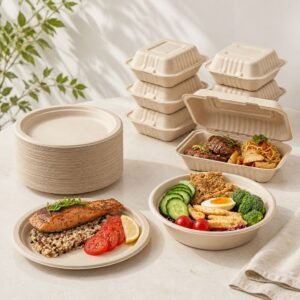
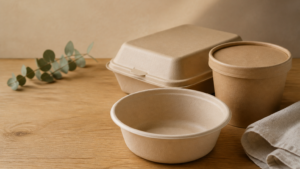
Paper soup bowls handle hot, wet, high-fat items and are the workhorse for lunch service. Salad bowls tend to be wider and shallower, and need a coating that resists oil-based dressings. For hot food, molded fiber clamshells and takeout boxes hold shape under steam and stack cleanly for delivery bags. Our paper soup bowls come with matched lids, which removes the most common source of leaks in delivery orders.
Getting the quantities right
Under-ordering costs you a mid-service emergency run. Over-ordering ties up cash and storage in a back room that was never big enough.
Start by calculating your busiest week, then order at a multiple that reflects your supplier’s price breaks rather than a round number. Unit price typically steps down at specific quantity thresholds, so ordering just above a break point usually costs less per item than ordering just below it — and leaves you with buffer stock instead of a shortage.
Check too that your core sizes match what your menu actually sells. A shop selling mostly 12oz and 16oz should not carry equal stock of every size.
What to ask a supplier before you order
Five questions separate a supplier worth committing to from one you will regret:
- Can I get samples of the exact SKU, with the lid? Test heat retention and lid fit on your own drinks before you commit to a pallet.
- What documentation covers food contact? Ask for the compliance paperwork for the specific item, not a company-level certificate — a certificate that does not name your SKU proves little. See our guide to packaging materials for how coatings differ.
- What is the minimum order quantity, and what are the price breaks? Get the full ladder, not just the headline MOQ.
- What is the lead time, and what is it during peak season? Demand spikes with event season and holiday trading.
- Can you custom print, and what does the plate cost? Custom printing is usually a per-colour plate charge plus a minimum run — worth it once volume is stable, wasteful before then.
Common mistakes to avoid
- Mixing wall types without telling staff. A single wall cup handed over without a sleeve produces a complaint that has nothing to do with your coffee.
- Buying lids separately to save a few percent. A leaking lid costs you far more in remade drinks and reputation than the saving.
- Assuming “compostable” covers the whole order. Bags, napkins, and cutlery are part of the claim.
- Ordering every size in equal quantity. Let your sales mix drive the shelf.
- Choosing on unit price alone. Delivered cost per drink served is the number that matters.
Getting started
If you are sourcing packaging for coffee shops for the first time, the fastest route is to start with your three highest-volume drink sizes, add matched lids, then extend to food containers once the drink side is stable.
We manufacture molded fiber and coated paper foodservice packaging in Thailand and supply coffee shops, restaurants, and catering operations worldwide. Talk to us about your setup — tell us your drink sizes and weekly volume, and we will suggest a starting configuration with matched lids and samples.