Buyers rarely get burned on compostable packaging because of price. They get burned on the gap between what a supplier said in the first email and what arrived six weeks later: a thinner bowl, a coating the certificate never covered, or a “compostable” claim that turns out to describe the resin rather than the finished article.
That happens because “compostable” is not a product specification. It describes a disposal outcome, and a dozen material and coating combinations can plausibly claim it. Vetting a compostable packaging supplier is therefore two jobs at once — proving the claim, and proving the product survives your menu.
This checklist follows the order problems actually surface, from the claim outward to the shipment.
Start With the Claim, Not the Catalogue
Before a supplier sends a price list, ask one question: which specific SKUs are covered by a compostability certificate, and who issued it?
A useful answer names the certifying body, the standard tested against, the certificate number and the production site. A weak answer says “our material is compostable” or attaches a certificate for a resin pellet you will never handle. Finished articles add coatings, adhesives and printing that a base-material certificate does not cover.
In North America the test method quoted is ASTM D6400; in Europe, EN 13432. BPI in the US builds its programme on those methods and verifies them through independent laboratories. None of these standards promise breakdown in a home heap or in landfill — industrial composting is the reference condition, worth saying to your own customers before they ask. We publish what each of our credentials covers on our certifications page; expect the same from anyone you shortlist.
The 10-Point Checklist
1. Certification scope, not just the logo
Read the product description line on the certificate. Check that your format — bowl, clamshell, plate, cup — appears there, and that the certificate is current rather than lapsed.
2. Food-contact compliance for your destination market
Compostability and food safety are separate questions. US suitability is assessed against FDA requirements for the material in direct food contact; the EU framework differs. A supplier selling into both should name both without hesitating.
3. Barrier chemistry, and whether it is PFAS-free
Fiber packaging needs a grease and moisture barrier, and the barrier is where PFAS entered this category. Ask what it is made of, whether it is a coating or a surface treatment, and request a written PFAS-free declaration for the finished article. Vague answers here devalue the certificate in point 1. Our materials guide compares the common barrier routes.
4. The temperature window of the actual SKU
“Microwave safe” and “heat resistant” get used interchangeably. Ask for a stated range and the duration it is rated for. Molded fiber tolerates short heat bursts far better than thin coated board tolerates sustained steam, and the failure mode — a base that softens and drops through — shows up in service, not in a sample photo.
5. Format coverage across your menu
One compostable packaging supplier for the whole line beats three that each hold one format, because mixed material families make a single waste stream impossible. Check whether one source covers bowls, plates, clamshells and cups, and whether those materials belong in the same composting stream.
6. Custom printing and tooling
Find out the print method, the minimum print run per size, and whether plate or die costs are charged again on repeats. Tooling on the first order and absorbed on repeats is normal; tooling on every order is a cost structure to know before quoting your own customers.
7. MOQ per SKU versus per order
Suppliers quote both, and they are different numbers. A 20,000-piece order across eight sizes can mean 2,500 per size — often below the economical forming or print run. Ask what the minimum is per size, and what it is per mixed order.
8. Lead time, split into its parts
Good suppliers separate production from transit; weak ones blend both into one optimistic number. Ask about the sampling loop as well — approved artwork to physical pre-production sample — because that stage loses most first orders a fortnight.
9. Consistency between shipments
Ask what tolerances the factory holds on gram weight and dimensions, and how cartons are packed and counted. A first shipment that matches the sample and a third that does not is a costing problem disguised as a quality problem.
10. Documentation speed and a single contact
Compliance paperwork and certificate renewals all need chasing. Time how fast a supplier answers a documentation request before you order; that response time predicts how they behave when a container is held at destination.
What to Ask For Before You Ask For a Price
A sample from the production line. Not a hand-assembled display piece. Ask whether it came off the same tooling your order will run on.
A spec sheet per SKU. Grammage, dimensions, capacity, coating, temperature rating, carton count, pallet configuration. A supplier who cannot produce this for the item you are buying is probably trading rather than manufacturing.
Certificate copies and test reports, on request, without friction — before the order, not after.
Test the Sample Like a Customer Would
Put hot, oily food in it and leave it thirty minutes. Microwave it for the stated time, then hold it by one edge. Stack ten loaded units and watch the bottom one. Try the lid one-handed, as someone in a queue would. Check whether a knife cuts through the base or slides.
Most specification failures surface in those five minutes, and they are far cheaper to find at sample stage than in a container.
Red Flags in the First Three Emails
- A generic catalogue PDF with no answer to your question
- “Compostable” with no certifying body named
- Price quoted before the specification is confirmed
- Certificates “available later”, after the order
- MOQ expressed only in containers, never per size
- No named contact, only a shared sales inbox
None is disqualifying alone. Two or three together usually are.
The Cost Question Is a Total Cost Question
Unit price is the easiest number to compare and the least useful alone. Add breakage and rework, the labour cost of a service failure at a busy counter, and the cost of material that cannot enter the waste stream you promised customers. A container a few cents dearer that performs reliably is usually cheaper once one peak-hour failure is priced in.
Where We Fit
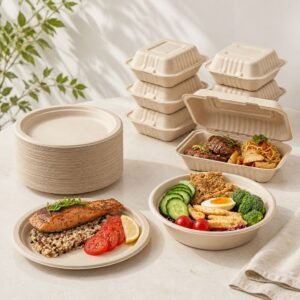
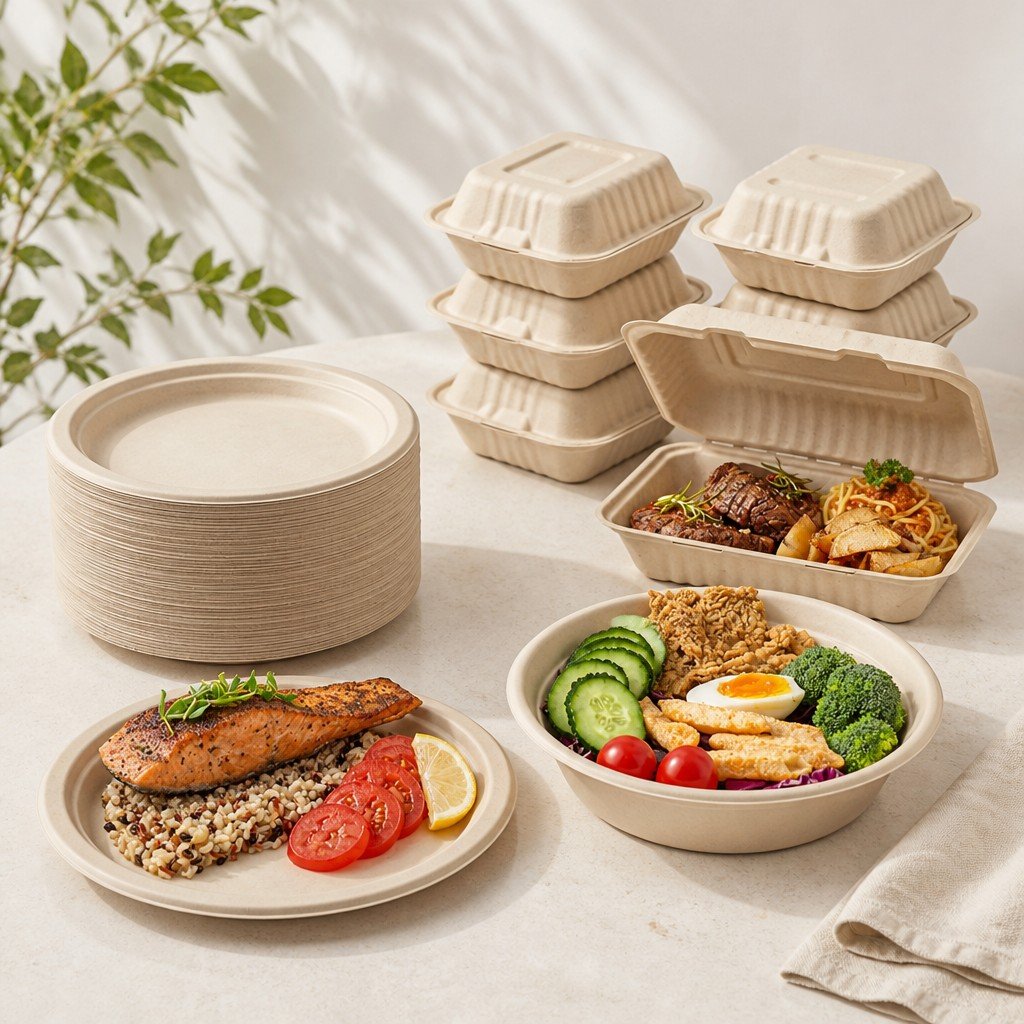
Max Green Pack is a compostable packaging supplier manufacturing molded fiber bagasse tableware and coated paper food packaging at our factory in Thailand, for the global food, catering and takeaway industries. Our bagasse range — plates, bowls, clamshells — is BPI certified for compostability, produced PFAS-free, and supported by documentation we send before you order rather than after. If you are comparing sources, the bagasse tableware range is a reasonable place to start a specification conversation.
Get a Spec Sheet and a Sample
Send your formats, sizes and expected volumes and we will reply with a per-SKU spec sheet, current certificate copies and a sample timeline — usually within one working day. Already have a supplier? Send the specification you are buying against and we will quote it line by line.